Readiness Is a Rate, Not a Number
Sustainment · June 5, 2026 · 6 min read
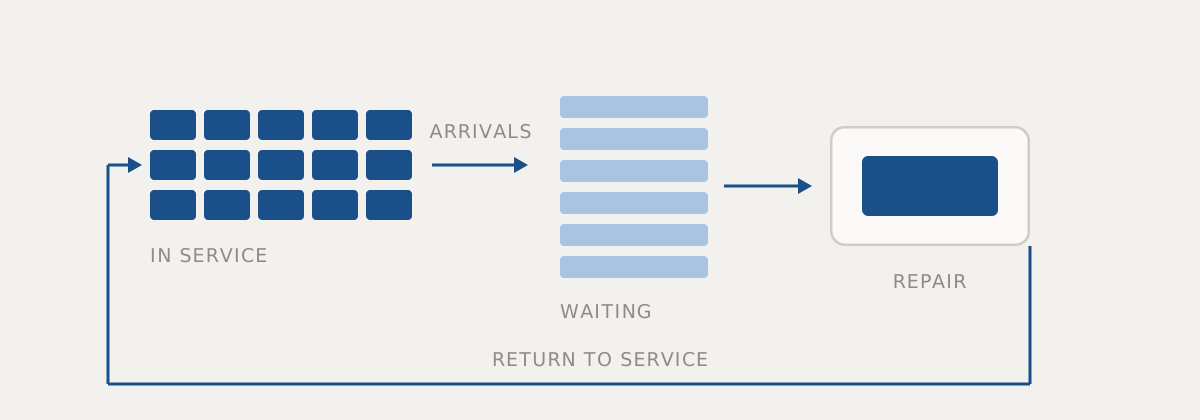
Readiness is almost always reported as a stock: a fraction of the fleet that could be used today. It is a comfortable number because it is a single number, and because it moves slowly enough to be argued about in a meeting. It is also the wrong shape for the thing it describes.
Availability is not a property of equipment. It is the steady state of a circulation — items leave service, join a queue, wait for a part, get repaired, get tested, and return. What a fleet reports on any given morning is a snapshot of that circulation, and a snapshot cannot tell you whether the level is falling or rising, or which of the four or five stages is holding everything up. Two fleets can report the same percentage while one is stable and the other is draining, and no amount of scrutiny applied to the percentage itself will distinguish them.
The useful reformulation is elementary. In steady state, the number of items sitting in the repair system equals the rate at which items enter it multiplied by the average time each one spends there. Suppose a fleet sends one item into the pipeline each day and each takes ten days to come back. Ten are out of service at any moment — and that is true whether the fleet has forty items or four hundred. Fleet size changes the fraction; it does not change the depth of the queue. Everything that matters is in the two terms on the right.
The arrival rate is set by usage, not by reliability alone
The rate at which work enters the repair system is the product of how hard the equipment is used and how often use produces a failure. Reliability programmes attack the second term, which is right, but the first term is the one that moves when the operating tempo changes, and it moves without warning.
This is why a sustainment posture that looks healthy at a peacetime rate can collapse at a higher one. Nothing about the equipment has changed. The arrival rate has doubled, the pipeline was already running near its capacity, and queues in a system near capacity do not grow proportionally — they grow much faster than that. A depot with a fixed number of test stands does not degrade gently as demand rises; it holds up, holds up, and then the backlog becomes the dominant term in the equation.
The percentage-of-fleet framing cannot anticipate this, because at peacetime tempo it looks fine. The rate framing predicts it, and it predicts it before the surge rather than during it.
Most of the time in the pipeline is not repair
The second term — time in the system — decomposes, and the decomposition is where the leverage is. An item that is out of service is doing one of several things: waiting to be diagnosed, waiting for a decision about where it will be repaired, waiting for a part, being worked on, waiting for test equipment, or waiting for transport back. Only one of those is repair.
In most pipelines the waiting dominates the working, and the largest single block of waiting is supply delay. That has an uncomfortable implication for how sustainment is usually funded, because the visible, defensible investments are in the repair stage — more technicians, better tooling, faster diagnostics — and those attack the smallest term. Halving a repair task that occupies a tenth of the residence time changes the answer by five per cent of a tenth. Cutting a supply wait that occupies half of it changes the answer by an amount you can see from orbit.
Which means the first sustainment question is not “how long does the repair take” but “what is the residence time at each stage, and what is its spread”. The spread matters as much as the average: a stage with a predictable two-week wait can be planned around, and a stage that takes two days most of the time and four months occasionally cannot. Variability, not the mean, is what forces every downstream stage to hold buffer.
Cannibalisation improves the number and damages the system
When an item is grounded for a part that will not arrive, there is an obvious local remedy: take the part from another item that is already down for something else. One aircraft flies. The reported number improves.
Three things happen underneath. The donor item now needs two parts instead of one, so its own residence time lengthens. The labour to remove and refit the part is real work that displaces other work in a capacity-constrained shop. And — most damaging — the demand signal disappears. The supply system learns about shortages through requisitions. A shortage solved by cannibalisation generates no requisition, so the forecast that drives next year’s buy is fed a picture in which the part was not needed.
This is a general property of local fixes in a flow system: they relieve the symptom at the measurement point and suppress the information that would have corrected the cause. A readiness figure that is being defended by cannibalisation is not a measurement any more. It is an output of the effort to protect the measurement.
What to instrument instead
Three quantities, reported together, say more than any single percentage.
Arrivals into the pipeline, by item and by cause, trended against operating hours. This separates a reliability problem from a tempo problem, which the availability figure cannot.
Residence time by stage, with its spread, not just its average. This identifies the binding constraint. It also survives reorganisation, because stages are physical things — a part is either waiting or being worked on — while organisational boundaries move.
Fill rate at the point of demand, meaning the share of requisitions satisfied from stock when first raised. Fill rate is the closest thing sustainment has to a leading indicator, because a falling fill rate lengthens residence time weeks before the availability figure notices.
None of these is exotic. All of them are usually collected somewhere and aggregated away before anyone senior sees them, because aggregation is what produces the single number that fits on the slide.
The deeper point is that readiness is a verb rendered as a noun. The equipment is not ready or unready; it is circulating through a system at a rate, and the rate is governed by arithmetic that does not care how the result is presented. Any sustainment decision that does not name which term it is trying to move — arrivals, residence time, or the buffer that absorbs their variability — is a decision about the number rather than about the fleet.