Dual-Use Is a Manufacturing Question First
Manufacturing · July 28, 2026 · 6 min read
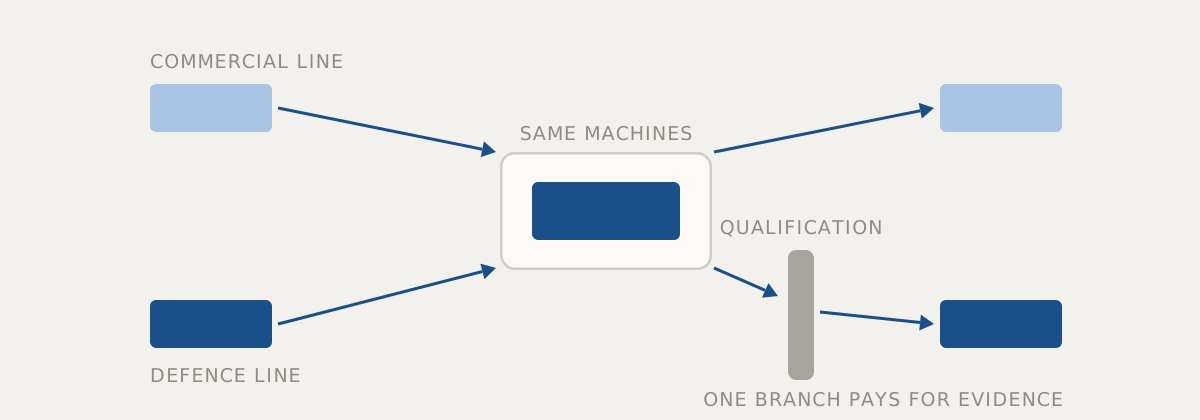
Dual-use is normally discussed as a policy category — which technologies have both civil and military application, and what should therefore be controlled. That framing is real and consequential, but it answers a different question from the one a manufacturer is actually asking, which is: can this line make both things?
The answer turns on a distinction that policy language obscures. Some parts of a manufacturing capability transfer between the civil and defence worlds almost for free. Other parts do not transfer at all, and the boundary between them is sharp, predictable, and mostly ignored in the enthusiasm to declare a sector dual-use.
What transfers well is capability. A five-axis machining centre does not know what it is cutting. Composite layup, additive processes, electronics assembly, welding procedures, heat treatment, metrology and the statistical process control wrapped around all of them are general competencies. A firm that holds them holds them for both worlds, and the capital equipment is the same equipment.
What transfers badly is the regime around the capability. Traceability to a specific material lot, configuration control, first-article inspection against a frozen process, restrictions on who may see a drawing or touch a part, and the rule that a nominally identical item from a different lot is a different item until proven otherwise. None of that is technology. All of it is overhead attached to a way of working, and it is the part that determines whether the line can actually take the job.
Two disciplines with opposite views of change
The deepest incompatibility is philosophical, and it explains most of the disappointment when commercial capacity is invited into defence production.
Commercial manufacturing improves through continuous change. The whole apparatus — kaizen, design for manufacture, value engineering, supplier development — exists to keep altering the process so the product gets cheaper and better. Change is the mechanism of improvement, and a line that has not changed in five years is a line that is losing money.
Defence qualification works the other way. The qualified article is the article that was made this way: this material lot, this supplier, this process, this inspection. The point of qualification is that its conclusions are only valid for the configuration that was tested, so change is not improvement — change is the invalidation of evidence, and re-establishing it costs calendar time.
Neither discipline is wrong. They are answering different questions: one is minimising unit cost over a large population, the other is bounding the probability of a failure whose consequences are not commercial. But a firm that has spent twenty years building an improvement culture is being asked, when it takes defence work, to run a second culture in which its core instinct is a defect. That is a management problem, not a technical one, and it is the reason the transition is hard even when the machines are identical.
The scarce resource is not spindle hours
There is a second, more concrete reason why commercial firms decline defence work or price it in a way that looks punitive.
A commercial line earns through volume and yield. Its scarce resources are changeover time and inspection capacity, not machine hours — machine hours are what it has been optimising to fill. A defence job typically brings low volume, high mix, long dwell, extensive documentation and disproportionate inspection. It consumes exactly the resources the line is short of and barely touches the one it has spare.
Priced honestly, the job therefore costs far more than a naive comparison of machine rates suggests, and the buyer concludes that industry is exploiting the situation. The mechanism is more boring than that. The comparison used the abundant resource as the unit of account. Any conversation about drawing commercial capacity into defence production that does not begin with changeover and inspection is measuring the wrong thing.
The same arithmetic explains where dual-use genuinely does work: upstream. Materials, castings, forgings, semiconductors, connectors, cells and other commodity inputs are consumed in volume by both worlds, and volume is what commercial economics is good at. Capacity is genuinely shared there, and an increase in defence demand can be absorbed without asking a firm to work against its own operating model.
Export control is a constraint on scheduling and hiring
Because export control is administered by lawyers, it is filed as a legal matter. Its effects on a factory are operational.
Controls determine who may access a technical data package, which constrains which engineers can be assigned and how quickly a team can be grown. They determine where equipment may be sited and where work may be sub-contracted, which constrains the use of overseas capacity that would otherwise absorb a peak. They require segregation — of networks, of storage, sometimes of physical areas — which consumes floor space and adds handoffs to a process flow.
The net effect is that a firm operating under controls does not have one global supply chain. It has several nationally partitioned supply chains that happen to share a design, each with its own qualified suppliers and its own capacity. The apparent redundancy across borders is frequently not available in the moment it would be needed, and the diagram that shows three suppliers may describe one usable supplier plus two that would require a licence, a re-qualification, or both.
None of this is an argument against controls. It is an argument for treating them as a manufacturing input with a cost and a lead time, rather than as paperwork that happens after the industrial plan is drawn.
Dual-use is decided at design time
The last point is the one with the most leverage, and it is nearly always missed because it has to be acted on early.
Whether a product can be built on shared commercial capacity is fixed when its process baseline is chosen. Design it around processes and materials that a broad commercial base already runs, accept the refresh cadence and change discipline that come with them, and shared capacity remains available for its whole life. Design it around a bespoke process qualified at one supplier — often for entirely good performance reasons — and shared capacity was never an option, because moving the work later means requalification against an article that is by then in service.
This is why exhortation does not produce dual-use industrial capacity. It is not a posture a factory can adopt; it is a property that a design either has or does not have, established at the point where somebody chose a tolerance, a material specification and an inspection regime. By the time the surge arrives, that choice is a decade old, and the only question left is which of the two clocks the design was built to run on.