Capacity Is a Decision Made Years Earlier
Industrial base · July 9, 2026 · 6 min read
The word surge implies a control that can be moved. Move it, and more comes out of the far end. Almost everything difficult about industrial capacity lives in the gap between that image and how output is actually produced.
Capacity and throughput are different quantities
Capacity is the maximum sustainable output of a system given its tooling, floor space, qualified operators and qualified sub-tier supply. Throughput is what comes out, and it is set by whichever of those runs out first.
Because the two words are used interchangeably in most discussions, a great deal of effort goes into raising things that are not the constraint. Adding a shift at final assembly raises assembly capacity, which was not binding; the parts still arrive at the rate the forge sets. The output does not move, the cost does, and the conclusion drawn is usually that the workforce underperformed.
The discipline is unglamorous: identify the single stage that limits the flow, express every proposal as an effect on that stage, and re-identify it after each change, because relieving one constraint promotes another. There is always a constraint. A system with no constraint is a system with idle capacity everywhere, which nobody pays for.
The constraint is rarely where the name is on the door
Final assembly is the visible end of the industrial base, and it is the elastic end. Assembly is largely space, fixtures and labour, all of which can be expanded on a timescale of months if the parts exist.
The inelastic stages sit further upstream and are mostly invisible from the top of the supply chain: large forgings and castings, specialised heat treatment and surface finishing, energetic materials, precision optics, certain classes of electronic component, and — running through all of them — people who have been doing the work long enough to do it to tolerance without scrapping the article.
Two structural features make the upstream hard. Its equipment is enormous, purpose-built and long-lead: the press, the furnace, the autoclave, the clean line. And the supplier of that equipment faces exactly the same problem, so the lead time to expand capacity includes the lead time to expand somebody else’s capacity. Expansion compounds backwards through the chain, and the total is measured in years regardless of how the order is worded.
Qualification is the gate nobody schedules
Suppose a second supplier exists, has the machine, and can make the part. It is still not a second source, because a source is not qualified until its output has been shown to perform on the article — often through testing to destruction, statistical sampling, and a first-article inspection against a frozen process definition.
This gate has an unusual economic property: money buys very little of it. The tests take the time they take, because their purpose is to observe behaviour over an interval. Adding people accelerates paperwork and does not accelerate a fatigue coupon. Which means qualification is nearly pure calendar time, arriving precisely when calendar time is what nobody has.
The practical consequence is that dual-sourcing is a decision to spend money during a period of calm in exchange for an option exercisable during a period of alarm. Its value is entirely in the option, and the option expires if the qualification was never finished. Half-qualified second sources are a common and expensive form of self-deception: the supplier appears in the diagram, and cannot ship.
Capacity is bought with order books, not intentions
Nobody builds a second line on the strength of a strategy document. A production line is a capital commitment repaid over years by volume, so the thing that causes capacity to exist is a contract with volume and duration attached — or a directly funded piece of tooling that the buyer owns.
This explains a pattern that is otherwise puzzling. Ministries announce priorities; suppliers do not expand; the suppliers are accused of a lack of patriotism or of an excess of shareholder discipline. Both readings miss the mechanism. A firm asked to add capacity for a demand signal that may be withdrawn is being asked to absorb a risk that it cannot price and did not create. It will decline, or it will price the risk into the unit cost, at which point the buyer complains about the price.
There are only three honest ways through. Commit to volume over a period long enough to repay the investment. Buy and own the tooling directly, so the supplier is being asked for labour and floor space rather than for capital at risk. Or pay explicitly for a standing option — a maintained but idle line — and recognise that idleness is the product being purchased, not waste to be eliminated at the next efficiency review.
The ratchet only turns one way
Capacity is quick to shed and slow to build, and the asymmetry is not primarily about machines.
A machine that is mothballed can usually be recommissioned. The workforce cannot be. When a line closes, the people who knew which settings the machine actually needs — as opposed to what the process sheet says — go elsewhere, retire, or move to a sector where their skills are less specialised. That knowledge is not in the documentation, because if it were fully in the documentation the training period would be short, and it never is.
Rebuilding it means apprenticeship: a novice working beside somebody who already knows, for as long as it takes. That is calendar time again, and it has the uncomfortable property of requiring the very experienced people whose absence created the problem. A capability lost for one generation of workers is not restored by restoring the funding.
The same asymmetry applies to sub-tier suppliers. A small firm that exits a qualified niche does not usually return, because re-entry means re-qualification against a customer who has already found another arrangement.
Where the risk is actually concentrated
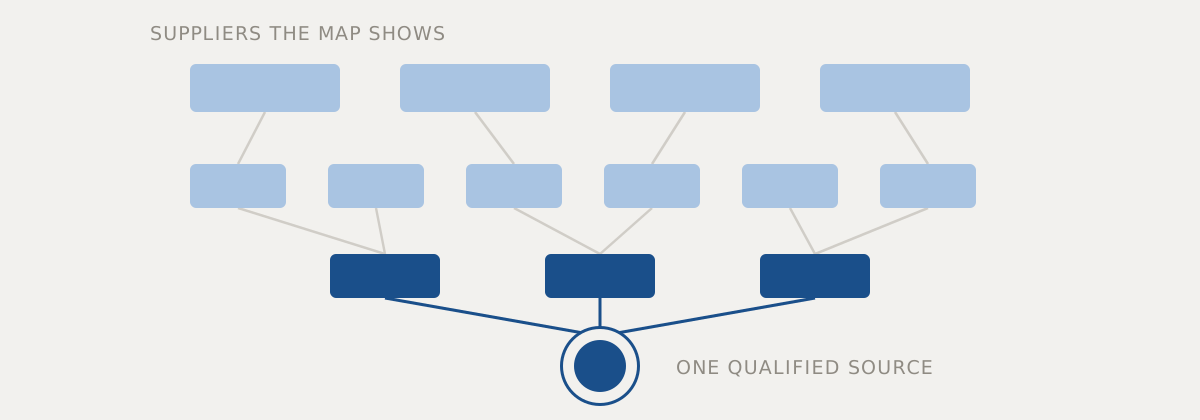
Supply-chain maps generally reach one or two levels below the prime, which is where the money is and where the reporting obligations stop. The concentration risk is usually three or four levels down, where a single mill, a single qualified coating shop, or a single producer of a precursor chemical sits behind suppliers that appear entirely independent of one another on the diagram.
Two second-tier suppliers, dual-sourced with care, can share one third-tier source and constitute a single point of failure that no amount of diligence at the second tier will reveal. Discovering this requires tracing the physical material rather than the contractual relationships — asking what the part is made of and where that came from, which is a metallurgy question rather than a procurement one.
Capacity, in the end, is not a dial and not a number in a plan. It is an accumulated set of decisions about tooling, qualification and people, most of them taken years before anybody asks what the capacity is. The only period in which capacity can be changed cheaply is the period in which nobody is asking.